

For any fire protection engineer, the fire sprinkler K-factor is the most fundamental design parameter. It is the bridge between the available water supply pressure and the actual water flow needed to suppress a fire. Choosing the incorrect K-factor can lead to a system that is either under-performing, leaving your facility at risk, or over-engineered, wasting significant budget.
As a specialized fire fighting equipment manufacturer, Hengdun Firefighting provides a comprehensive range of K-factor options to ensure your hydraulic calculations are perfectly balanced.
What is a Fire Sprinkler K-Factor?
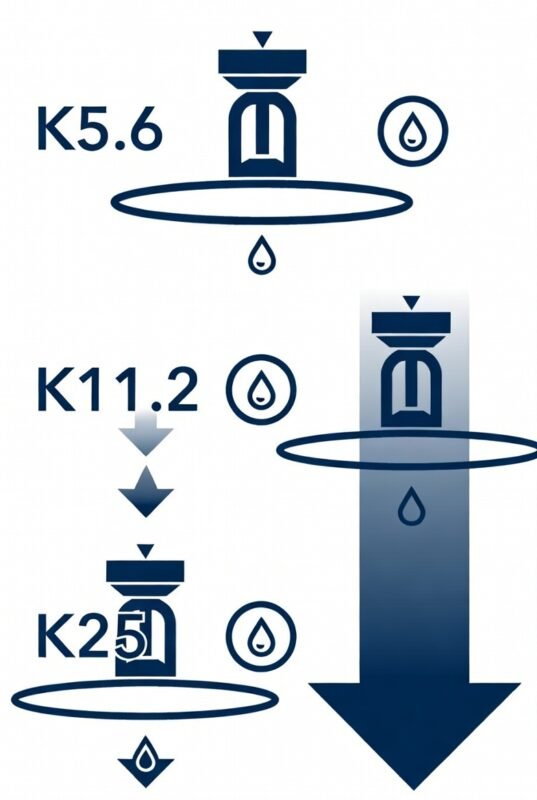
The K-factor is a mathematical constant that describes the discharge coefficient of a sprinkler orifice. In simple terms, it determines how much water flows through the sprinkler head at a specific pressure.
The formula used by designers is: Q = K × √P
- Q: Flow rate (GPM or LPM)
- P: Pressure at the sprinkler head (PSI or Bar)
- K: The K-factor (the discharge coefficient)
Essentially, a higher K-factor means more water will be discharged at the same pressure compared to a lower K-factor sprinkler.
Why K-Factor Selection is Crucial for Safety
Selecting the right K-factor is a balancing act between the available water supply and the hazard classification of the building.
- Light Hazard (Offices/Residential): Usually utilizes standard K5.6 or K8.0 heads, where lower water demand is required.
- High-Piled Storage (Warehouses): Requires high-discharge heads like K14.0, K16.8, or even K25 (ESFR) to penetrate high-velocity fire plumes.
If you choose a sprinkler with a K-factor that is too low for the hazard level, the system will fail to provide the required water density to suppress the fire. Conversely, choosing one that is too high may exceed the capacity of your fire pump or water storage tank, leading to system failure.
Practical Selection Criteria
When designing your fire sprinkler systems, consider these three criteria based on NFPA 13 standards:
- Commodity Hazard Classification: Refer to the NFPA 13 tables. High-hazard commodities, such as plastics or aerosol products, require significantly higher K-factors to ensure effective suppression.
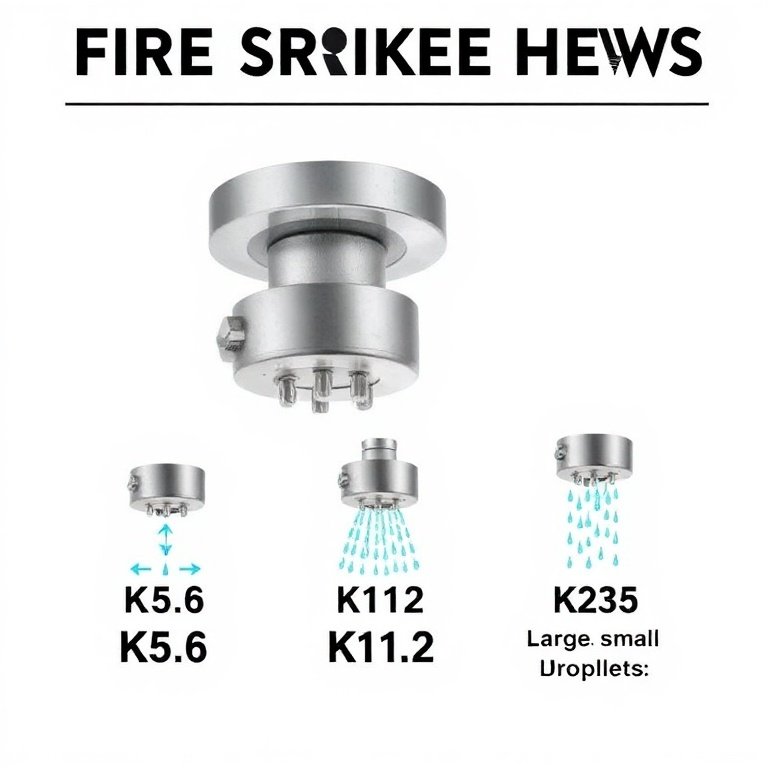
- Ceiling Height: As ceiling heights increase, you need a higher K-factor sprinkler with larger droplets to prevent the fire plume from evaporating the water before it reaches the fuel source.
- Water Supply Pressure: Your hydraulic calculations must prove that the water supply can sustain the K-factor demand. If your fire pump output is limited, choosing a sprinkler with a lower K-factor might be necessary.
Manufacturing Quality: The Hengdun Advantage
At Hengdun Firefighting, we understand that hydraulic design is only as good as the hardware installed. We manufacture a full series of K-factor sprinklers—from K5.6 to K25 (ESFR)—ensuring that your project’s hydraulic demand is met with reliable, high-precision components.
Every batch undergoes rigorous discharge testing to ensure the actual K-factor matches our specifications, giving your engineering team the confidence that theoretical calculations will perform exactly as expected in a real-world emergency.
FAQ: Sprinkler Hydraulics
Does K-factor affect sprinkler temperature rating? No. They are independent. The K-factor determines flow volume, while the temperature rating determines the activation timing.
Can I mix K-factors in the same system? Generally, no. Mixing K-factors makes hydraulic calculations extremely complex and is usually discouraged by building codes to ensure uniform water distribution.
Conclusion
Mastering K-factor selection is the mark of a skilled fire protection designer. It ensures that your system is efficient, compliant, and—above all—capable of saving lives.
Designing a complex fire protection project? Contact our experts to get technical data sheets and expert advice on choosing the optimal K-factors for your facility.